East India Company Ensign
/vexillology/atlas/east_india_company
About
This page follows the striped ensign of the English East India Company across the sources collected in the Historical Flag Atlas. The Company's flag is a rewarding subject for a copying-tradition study precisely because it appears so often: nearly every chart in the collection that predates or brackets the Company's end includes it, and no two draw it quite alike. Three direct depictions are currently catalogued, spanning c. 1720 to c. 1864 — the last printed after the Company's rule in India had already ended.
Status: Preliminary. The documented history below is assembled from general accounts; full citations remain to be secured.
Documented Flag History
The Company's ensign was a field of red and white horizontal stripes with a canton at the upper hoist. The canton tracked the English and then British national flag: St George's cross in the seventeenth century, the Union flag after 1707, and the Union with St Patrick's saltire after 1801. The number of stripes was never rigidly fixed — surviving records and depictions give counts from about nine to thirteen — so variation among charts reflects variation in practice, not only copying error.
The design is often noted as a visual ancestor or twin of early American flags: the Continental Colors of 1775 differ from the Company's ensign essentially not at all. The Company lost its trading monopolies in 1813 and 1833, and after the rebellion of 1857 its rule in India was ended by the Government of India Act 1858; the Company itself was formally dissolved in 1874. Any appearance of the ensign in a source after 1858 is therefore an archaism.
Collected Depictions
| Source date | Source | Printed attribution | Study |
|---|---|---|---|
| c. 1720 | Flaggen aller seefahrenden Potenzen und Nationen | Engl: Ost-Indianische Compagnie | Note below |
| 1837 | Pavillons et Cocardes | Angleterre — Compagnie des Indes Orientales | Note below |
| c. 1864 | Johnson's New Chart of National Emblems | East India Company. | Note below |
Two panels of the c. 1769 Encyclopédie plate are related without depicting the English Company's ensign: figure 55, the Pavillon des Indes orientales d'Ecosse — the flag of the Company of Scotland, defunct since 1707 and already the subject of a study seed in the source notes — and figure 78, a Pavillon des Indes orientales bearing interlaced company letters, whose company has not yet been identified. The c. 1720 sheet likewise prints the Dutch East and West India Companies under their monograms — evidence of how routinely the chartered companies stood among nations on these charts.
Note: the c. 1720 Depiction
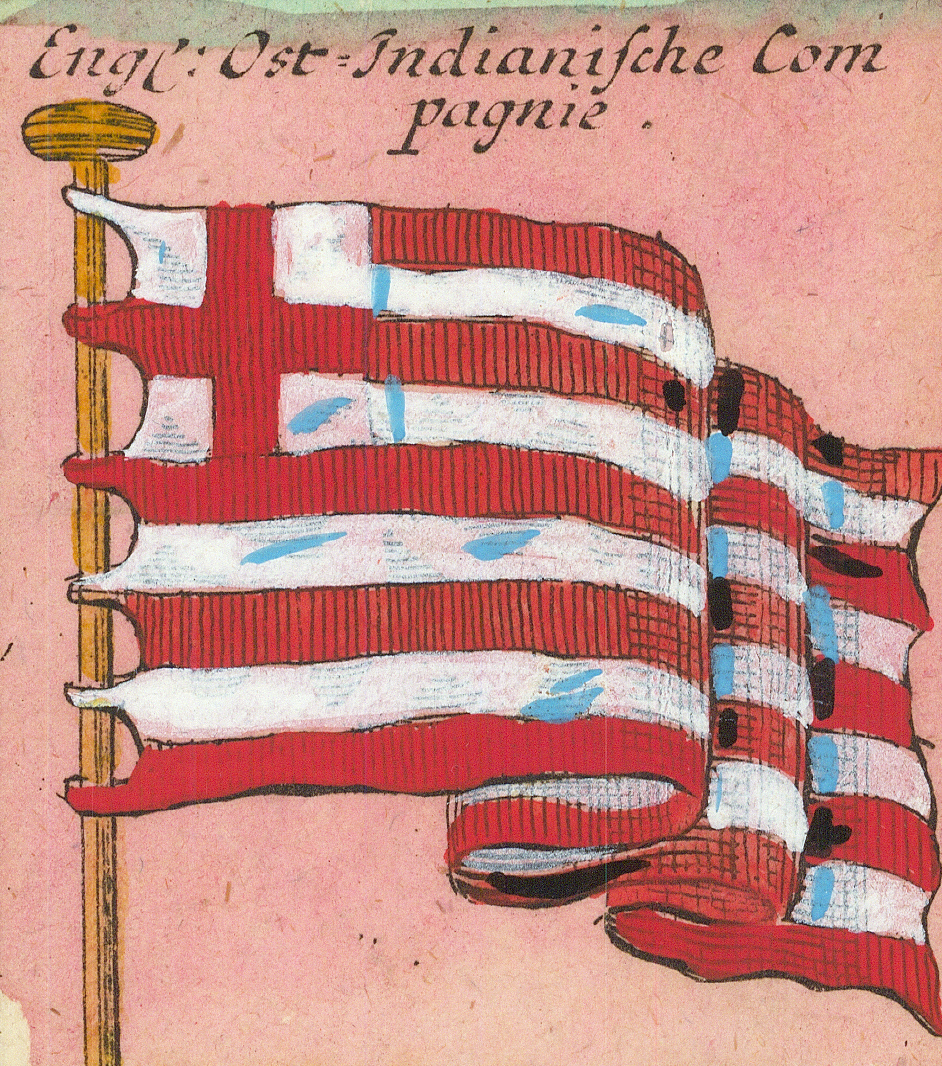
The Homann sheet draws about nine stripes, red uppermost, with a St George's cross canton on white. By the sheet's assigned date the Union canton had been prescribed for more than a decade (1707), so the St George form is either an older model carried forward — entirely in keeping with the sheet's methods — or a record of the older form's persistence at sea. Either way it preserves the seventeenth-century face of the ensign.
Note: the 1837 Depiction
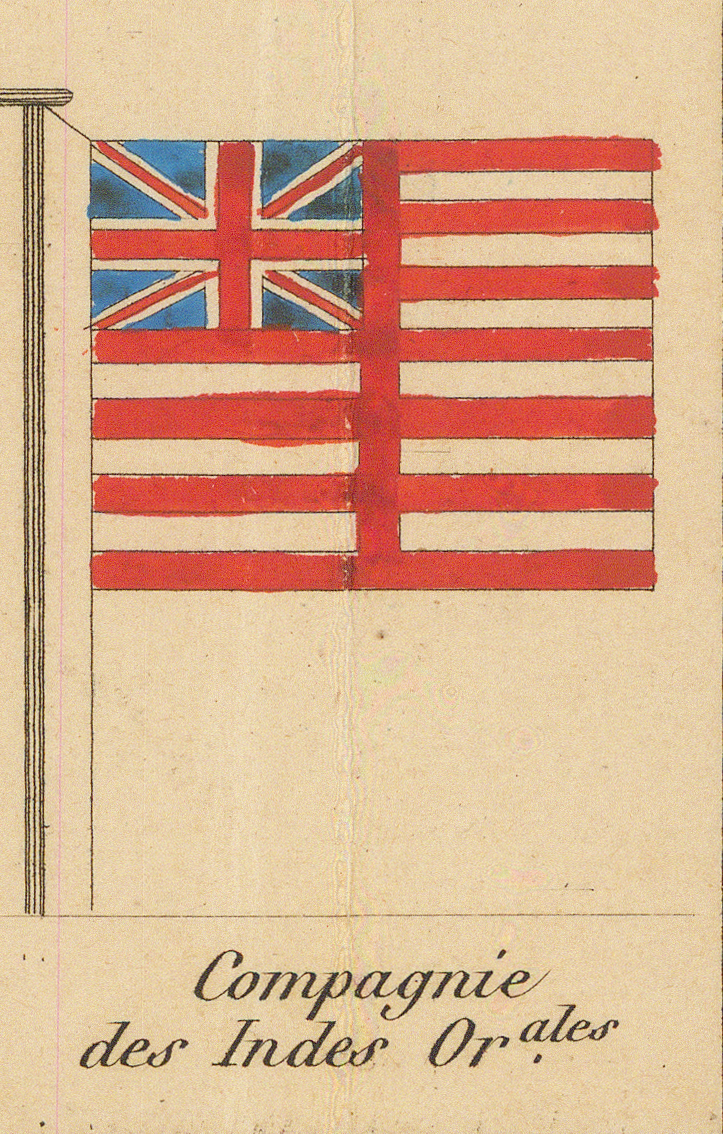
The 1837 Paris sheet — drawn d'après des documens officiels — gives the fullest form in the collection: thirteen stripes, red uppermost, under the post-1801 Union canton with St Patrick's saltire, the canton spanning the upper five stripes. In 1837 the Company still governed India, so this panel records a current flag, and its thirteen-stripe count matches the best-documented late form of the ensign.
Note: the c. 1864 Depiction
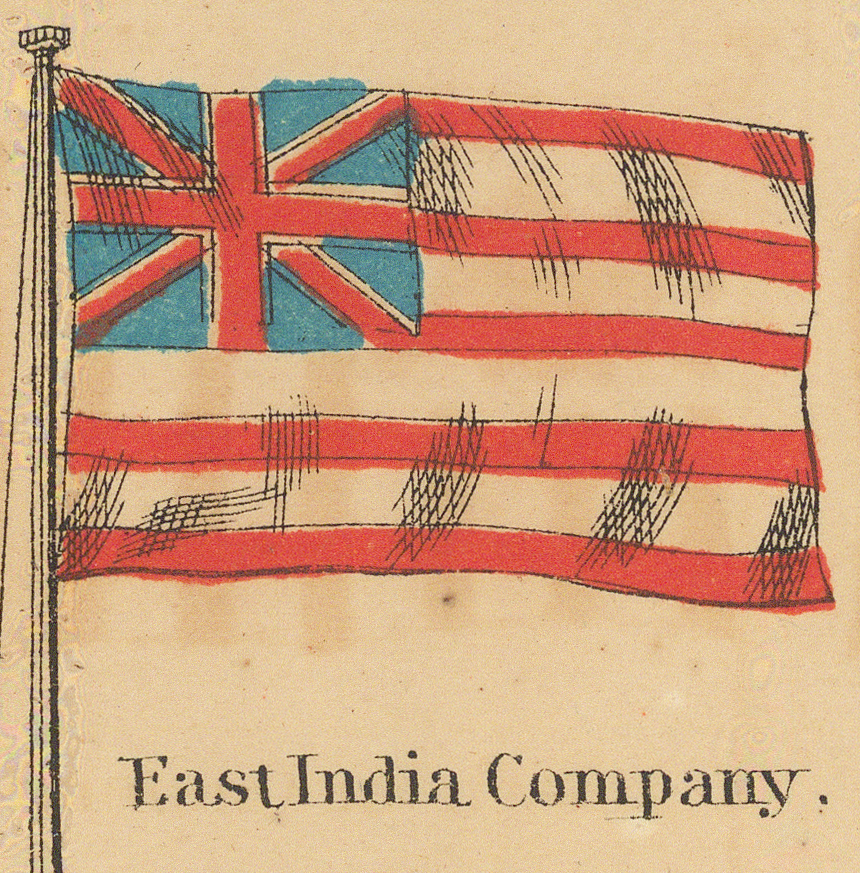
Johnson's chart draws the ensign loosely — about seven stripes, red uppermost, under a Union canton — and prints it among the British flags of the first row. By the chart's copyright year the Company's rule in India had been over for five years; the panel is the collection's terminal sighting of the ensign, surviving in print as the Morocco “scissors” and the Persian lions survive elsewhere on the same sheet: by inheritance from older charts rather than from the sea.
Observations Across the Chain
Read in sequence, the three panels show the two axes on which the ensign varied. The canton tracks the national flag — St George (1720), Union with St Patrick (1837, 1864) — and is the reliable dating element. The stripe count drifts freely — nine, thirteen, seven — and is evidence of how loosely the design was specified and copied; the Company's own practice varied, and the charts amplify that variation. A fuller study could compare these counts against documented Company records and the other chart traditions.
References
- Flaggen aller seefahrenden Potenzen und Nationen, panel Engl: Ost-Indianische Compagnie, in the present collection.
- Pavillons et Cocardes des Principales Puissances du Globe, panel Compagnie des Indes Orientales, in the present collection.
- Johnson's New Chart of National Emblems, panel East India Company., in the present collection.
- General accounts of the Company ensign's canton changes (1707, 1801) and stripe variation, and of the end of Company rule (1858) and dissolution (1874). Full citations pending.
© Encyclopaediae. Open educational reference project.