Hawaii (Sandwich Islands)
/vexillology/atlas/hawaii
About
This page follows the flag of Hawaii across the sources collected in the Historical Flag Atlas. It places documented flag history beside the printed depictions, keeping the two visibly distinct: what a publisher printed is evidence of what that publisher represented, not automatic proof of what was flown.
Depictions are studied in chronological order of their sources. Three depictions are currently catalogued.
Status: Preliminary. The documented history below is assembled from the sources gathered in the study notes; several citations remain to be completed and are marked accordingly.
Names
European sources of the eighteenth and nineteenth centuries commonly call the archipelago the Sandwich Islands, the name given by James Cook in 1778; the c. 1863 plate in this collection prints Sandwich (Iles). The kingdom unified under Kamehameha I in the early nineteenth century is referred to here as Hawaii or the Hawaiian Kingdom. Printed labels are preserved as transcribed in each study.
Documented Flag History
The Hawaiian flag combines a Union Jack canton with a field of horizontal stripes; the canton reflects the kingdom's early association with Britain. The flag's origin is conventionally dated to the reign of Kamehameha I, around 1816.
The arrangement in use from 1845 onward has eight stripes, ordered white, red, blue repeating from the top, the eight stripes representing the eight principal islands under one sovereign. This arrangement was published in the Polynesian newspaper of 31 May 1845; an account cited in the study notes suggests the adoption may date two years earlier, to the restoration of sovereignty in 1843.
Before 1845, descriptions and depictions vary considerably. Seven stripes are commonly reported, in differing orders: an 1831 translation describes the order “red, white, blue, red, white, blue, red, signifying seven islands,” and a recollection published in 1864 states that “the number of the stripes betoken 7 islands which are under the government Tameamea.” Visitors of the period likewise mention many variations, and some foreign publications printed striped flags for the islands that more closely resemble the flag of the East India Company. According to the account cited in the notes as Reversal of the Hawaiian Flag, the stripe order was reversed when the flag was reissued, in reference to the overturn and restoration of the government.
Three political dates matter for reading foreign attributions: the islands were ceded under duress to Captain Lord George Paulet on 25 February 1843, during which Hawaiian flags were ordered burned — when Commodore Kearny requested one in July, none could be found; sovereignty was restored by Rear-Admiral Richard Thomas on 31 July 1843; and Britain and France jointly recognized Hawaiian independence on 28 November 1843. No British protectorate existed thereafter.
Collected Depictions
| Source date | Source | Printed attribution | Study |
|---|---|---|---|
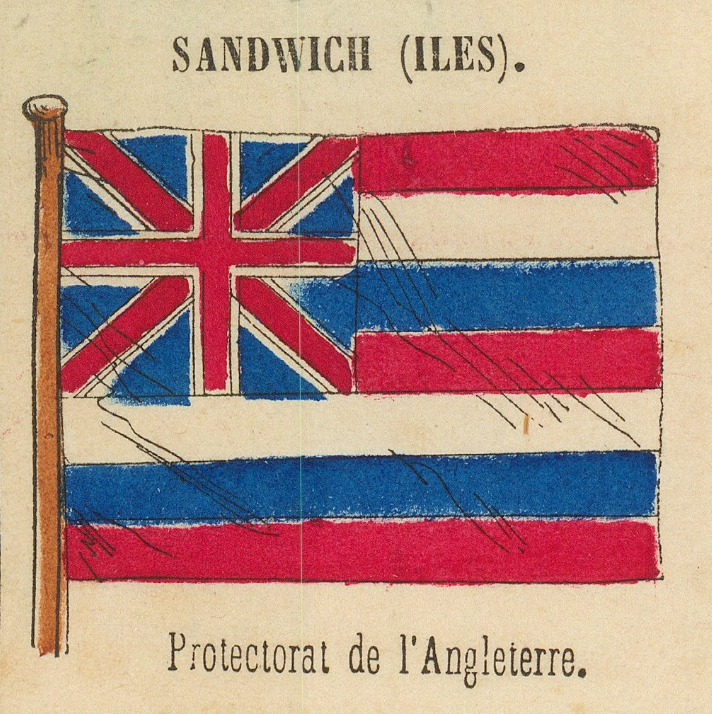
| c. 1863 | Pavillons des principales puissances | Sandwich (Iles) — Protectorat de l'Angleterre | Study below |
| c. 1864 | Johnson's New Chart of National Emblems | Hawaiian Islands. (Sandwich Islands.) | Note below |
| c. 1899 | Flags of All Nations | Hawaii | Note below |
Study: the c. 1863 Depiction
Source and printed label
The panel appears in the Puissances étrangères division of Pavillons des principales puissances (Armand Le Chevalier, Paris, c. 1863). The printed heading is Sandwich (Iles); the printed caption is Protectorat de l'Angleterre (“protectorate of England”).
Observation
The depiction shows a rectangular flag with a Union Jack canton at the upper hoist, spanning the depth of the upper four stripes. The field consists of seven horizontal stripes reading, from the top: red, white, blue, red, white, blue, red. Neither the top nor the bottom stripe is white. The panel is hand-coloured with visible hatching and colour bleed, as elsewhere on the plate.
Documented comparison
The flag in force at the plate's date — published in the Polynesian of 31 May 1845 and unchanged since — has eight stripes ordered white, red, blue from the top. The depiction disagrees with it twice over: in stripe count (seven, not eight) and in order (red first, and no white edge stripe at top or bottom).
The depiction does, however, agree stripe-for-stripe with a pre-1845 arrangement attested in the sources gathered in the notes: the 1831 translation's “red, white, blue, red, white, blue, red, signifying seven islands,” read from the top down, is exactly the sequence printed here, and the seven-stripe count matches the 1864 recollection that the stripes “betoken 7 islands.”
Interpretation
The most economical reading is that the plate reproduces an obsolete but genuine earlier arrangement of the Hawaiian flag rather than misdrawing the current one: both the count and the order match pre-1845 descriptions, which makes coincidental error less likely, though the drawing and colouring conventions of the plate leave room for it. This would be consistent with copying from an older source or predecessor plate rather than from contemporary observation — a common practice, and one in keeping with the wide inconsistency of foreign depictions of this flag noted throughout the period.
The protectorate attribution
The caption Protectorat de l'Angleterre is a separate anomaly, and rests on different evidence. Britain and France had jointly recognized Hawaiian independence in November 1843, and no British protectorate existed at the plate's date. The attribution may echo the brief 1843 Paulet cession, the kingdom's longstanding British association — visibly symbolized by the canton itself — or simply an older or derivative source. Whatever its origin, it records how a Parisian publisher of the early 1860s classified the islands, which is itself evidence of contemporary European understanding, or misunderstanding, of Hawaiian sovereignty.
Alternatives and remaining uncertainty
Alternatives that cannot yet be excluded: that the depiction is a colourist's or engraver's error that happens to match older descriptions; that it copies a specific intermediate source not yet identified; or that seven-stripe flags in the older order remained in some circulation or memory later than the documented adoption suggests. The account of the stripe reversal, and the 1831 and 1864 quotations, are known to this page through the preliminary notes; their full citations remain to be secured, and the interpretation above should be reweighed once they are.
Confidence
High: the depiction is intended as the flag of Hawaii, and the protectorate attribution was obsolete or incorrect at the plate's date. Moderate: the depicted arrangement corresponds to a genuine pre-1845 form, per the sources cited in the notes. Tentative: the explanation of how that older form reached this plate.
Note: the c. 1864 Depiction
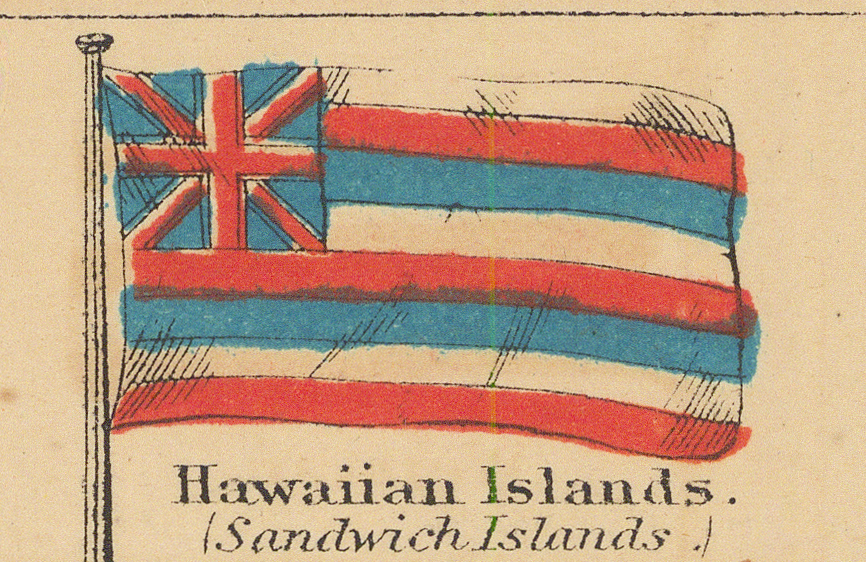
The panel occupies a position of some prominence: one of only two small panels flanking the title at the head of Johnson's New Chart of National Emblems (Johnson & Ward, New York, copyright 1863). The caption gives both names — Hawaiian Islands. (Sandwich Islands.) — and, unlike the French plate of the same years, attaches no political qualifier: no protectorate, no association, simply a kingdom among the nations.
The depiction shows the Union Jack canton over eight stripes in the documented order — white, red, blue repeating from the top, red at the bottom, the arrangement in force since 1845. As on the later c. 1899 sheet, the topmost white stripe is simply unprinted paper inside the drawn outline and is easy to overlook, but the count and order are correct. The drawing is careful for its scale: the canton spans the upper four stripes, as documented.
This makes the panel a pointed counter-example to its French contemporary. Within a year or two of one another, the Paris plate printed an obsolete seven-stripe red-first arrangement under an obsolete protectorate caption, while the New York chart printed the current flag accurately, under both current names and no political qualifier at all. Whatever older model Le Chevalier's plate copied, Johnson's compiler was evidently working from better information here — which sharpens, rather than softens, the question posed in the 1863 study of where the French depiction came from.
Note: the c. 1899 Depiction
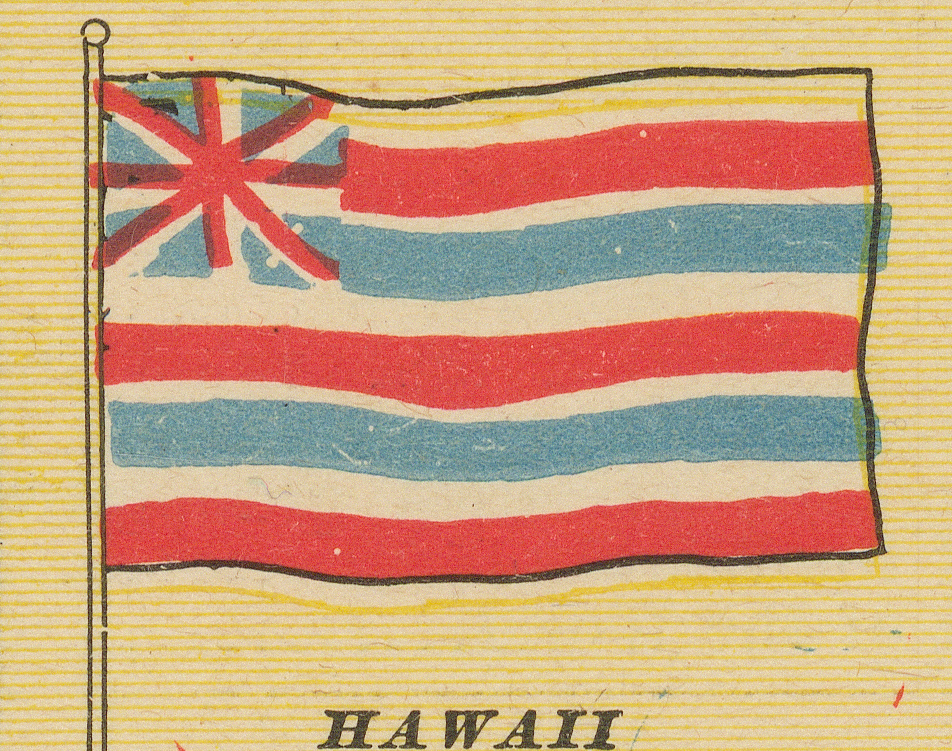
The panel appears among the nations of the eighth row of Flags of All Nations (American, c. 1899), captioned simply Hawaii, with no political qualifier. The depiction shows the Union Jack canton and eight stripes in the documented order — white, red, blue repeating from the top, red at the bottom, the arrangement in force since 1845. The printing is loose: the white stripes are simply unprinted paper, the stripe widths are uneven, and the topmost white stripe is nearly pinched out between the drawn outline and the first red, so that at a glance the flag can read as red-first. Allowing for the sheet's mass-market colour work, the depiction is correct in both count and order, and no fuller study is planned.
Its chronological interest is mostly in what surrounds it. The sheet brackets to about 1896–1902: the Republic of Hawaii was annexed by the United States in August 1898 and formally organized as a territory in 1900, yet the publisher still presents Hawaii as a nation among nations, without any reference to the United States. Unlike the c. 1863 panel — whose seven-stripe arrangement and protectorate caption were both anachronisms — nothing about the flag's presence here is out of order (the c. 1864 Johnson panel had already printed the eight-stripe flag correctly): the design itself continued in use under the republic and the territory, and this panel records it near the moment its sovereignty, but not its flag, disappeared.
References
- Pavillons des principales puissances, panel Sandwich (Iles), in the present collection.
- Johnson's New Chart of National Emblems, panel Hawaiian Islands. (Sandwich Islands.), in the present collection.
- Flags of All Nations, panel Hawaii, in the present collection.
- The Polynesian (Honolulu), 31 May 1845 — publication of the eight-stripe arrangement. Full citation pending.
- Reversal of the Hawaiian Flag — account of the stripe reversal, quoting an 1864 recollection and an 1831 translation. Full citation pending.
© Encyclopaediae. Open educational reference project.